
The Short Answer
PPF and ceramic coating protect against different categories of damage, which means neither one replaces the other. If you can only do one, PPF on the front-end impact zones comes first for most Long Island drivers. That is the area that takes rock chips, salt spray, and highway debris on the LIE and Sunrise Highway, and rock chips are the only form of paint damage that ceramic coating cannot prevent.
If you have the budget for both, install PPF on the high-impact zones first and then apply ceramic coating over the entire vehicle, including on top of the PPF itself. That combination is the highest level of protection available short of garaging the car.
The rest of this post explains why.
What PPF Protects Against
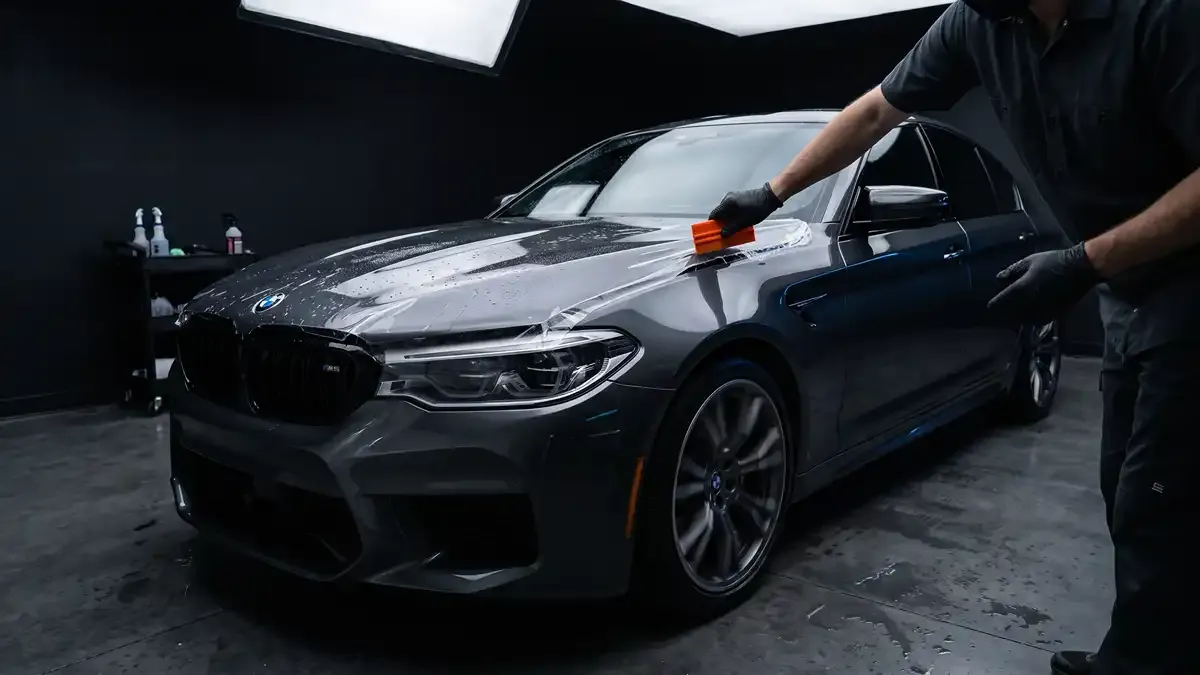
Paint protection film is a clear urethane film, roughly 8 mils thick, that is applied directly over the paint. It is a physical barrier. What it stops:
- Rock chips from highway driving
- Road debris impacts on bumpers, hoods, fenders, and mirrors
- Light scratches from gravel, tree branches, and minor contact
- Some stone pitting on lower rockers and door edges
Because PPF is a film rather than a coating, it has thickness. That thickness absorbs energy. A pebble flicked up by a car ahead of you on the LIE hits the film, flexes it, and bounces off. On unprotected paint, the same pebble leaves a permanent chip through the clear coat and into the base color.
Modern PPF is also self-healing. Light swirl marks and fine scratches disappear when the film warms up (parked in the sun, or a pass with warm water). That’s a chemistry feature of the urethane, not a coating.
What Ceramic Coating Protects Against
Ceramic coating is a liquid polymer that bonds chemically to the clear coat, forming a hard, hydrophobic layer. It is a surface chemistry upgrade, not a physical barrier. What it stops:
- UV fade and oxidation from sun exposure
- Chemical etching from bird droppings, tree sap, bug splatter, and industrial fallout
- Water spots from hard water and salt-laden rain
- Light scratches at the wash stage (because contaminants slide off instead of gripping the paint)
- Staining from road grime and pollutants
The hydrophobic effect is the visible feature, water beads up and rolls off, and so does most contamination with it. Maintenance gets easier. A rinse does most of the work of a wash. But ceramic coating does not stop a rock. It is a chemical shield, not a mechanical one.
Where They Overlap, and Where They Don’t
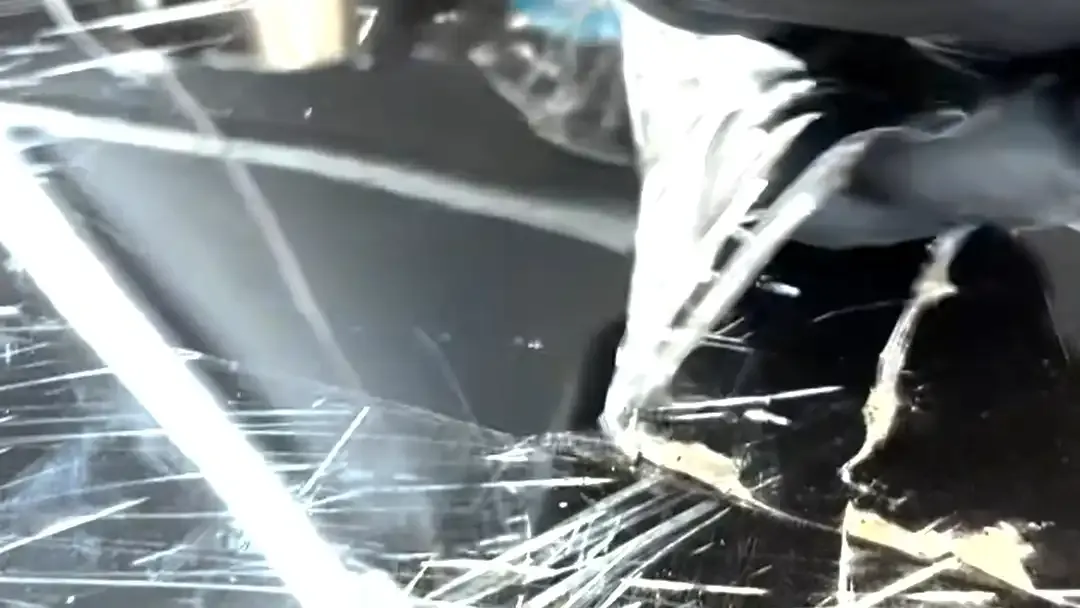
The difference that matters most is impact, and it is easier to show than to describe. This is film on a test panel taking a hammer, a screwdriver, and a drag across asphalt, including the point where we pushed past what the film can hold:

No coating does that, for reasons covered in does PPF actually work.
The overlap: both protect against UV damage to some extent, and both make a surface easier to clean.
The critical non-overlap:
| Damage Type | PPF | Ceramic |
|---|---|---|
| Rock chips | ✓ | ✗ |
| Stone pitting | ✓ | ✗ |
| Scratches (moderate) | ✓ | partial |
| UV fade | partial | ✓ |
| Chemical etching | ✓ | ✓ |
| Hydrophobic / easy clean | partial | ✓ |
| Self-healing | ✓ | ✗ |
The takeaway: PPF is stronger where physical impact is the threat, ceramic is stronger where chemistry and UV are the threat. Most cars, most of the time, face both.
Why Long Island Makes the Decision Easier
If you live somewhere with clean roads, no weather extremes, and garage parking, you could reasonably skip PPF and just do ceramic. But Long Island specifically punishes unprotected paint in three distinct ways:
- Highway rock chips. The LIE, Sunrise Highway, and Northern State throw enough loose asphalt, gravel, and road debris at front ends that every unprotected commuter vehicle accumulates visible chips within two years. PPF is the only thing that stops this.
- Winter road salt and brine. Both PPF and ceramic resist salt, but ceramic coating is the more effective barrier because salt damage is mostly chemical rather than mechanical. The hydrophobic effect means salt-laden water sheets off rather than sitting on the paint.
- Summer UV and coastal air. South-shore and North-shore drivers both see accelerated clear-coat oxidation from UV, with coastal drivers getting an extra layer of salt-mist corrosion. Ceramic coating is the right answer for both.
So: rock chips favor PPF, salt favors ceramic, UV favors ceramic, and real-world daily driving on Long Island involves all three.
The Cost Question
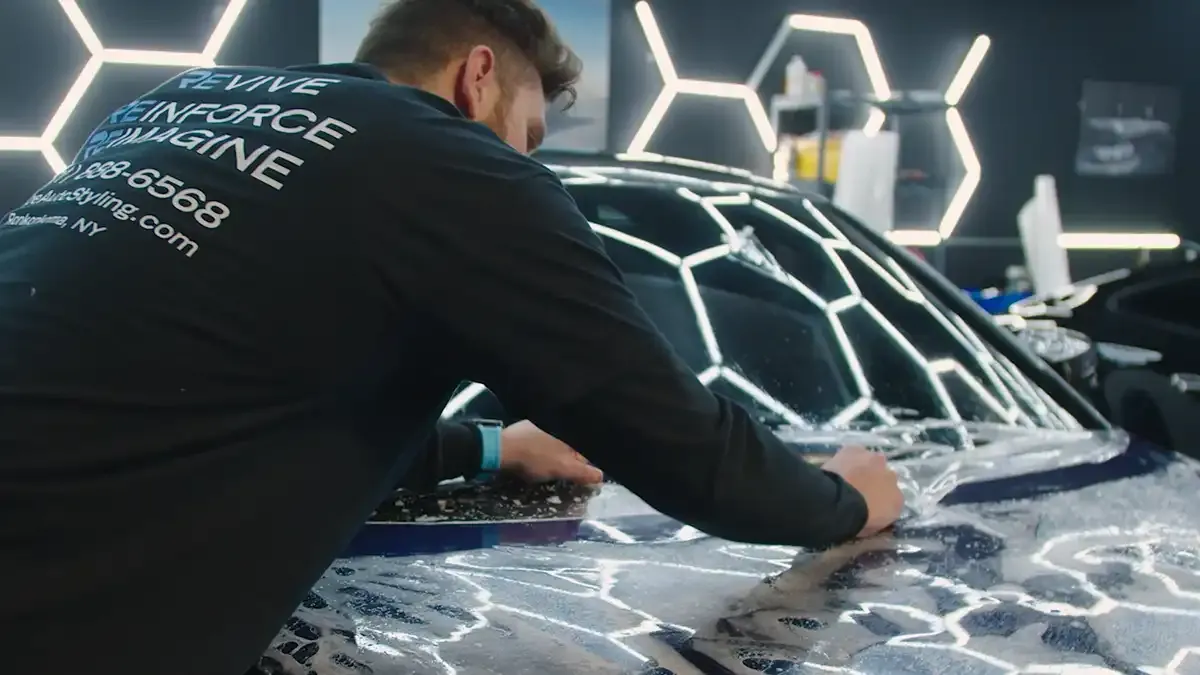
PPF costs significantly more than ceramic coating at every package tier. That’s because PPF is a labor-intensive installation of a physical film with precise templating, heat-shaping, and edge-wrapping, while ceramic coating is a chemical application process after prep.
Exact numbers depend on vehicle size and scope, but roughly:
- Full-front PPF: several thousand dollars, covering bumper, hood, fenders, mirrors, and headlights
- Full-body ceramic coating: under half of full-front PPF at comparable package tiers, covering every painted surface
For specific pricing, see our dedicated posts: how much ceramic coating costs on Long Island and how much PPF costs on Long Island.
If you’re budgeting, understand that PPF pays back in avoided paint damage. A set of rock chips deep enough to need paint repair costs roughly what full-front PPF costs in the first place. And unrepaired chips hurt resale value by more than the PPF price.
Which One First? Scenario by Scenario
New vehicle, plan to keep it 5+ years
PPF front end immediately, before you put miles on it. Follow with ceramic coating either the same day or within a month on the PPF and on all the paint PPF doesn’t cover.
Used vehicle, want to protect it going forward
Paint correction first (to remove existing defects), then ceramic coating on all surfaces. Consider adding PPF later on the front end if the car will see regular highway miles. Never ceramic over defects you haven’t corrected, the ceramic locks them in.
Daily driver that sees highway miles
Full-front PPF is the highest-impact single investment. Ceramic on top if budget allows.
Weekend or garage-kept car
Ceramic coating is usually enough. PPF is optional and only worth it if the car is going to be driven hard or on rough roads.
Truck or SUV used for work
PPF on the front bumper and hood (the areas that see gravel and debris), ceramic coating everywhere else, and undercarriage rust protection before winter.
Show car or high-value build
Full-body PPF is the standard, often with ceramic coating layered on top. Ceramic alone leaves chips possible; PPF alone misses out on the hydrophobic maintenance benefits.
The Combination Is the Real Answer
For drivers who want comprehensive protection, the standard setup is:
- Paint correction on any existing swirl marks, oxidation, or etching (required before either product)
- PPF on the front-end impact zones: bumper, hood, fenders, mirrors, headlights
- Ceramic coating over everything, including the PPF itself
This gives you a physical barrier on the high-impact zones and a chemical barrier on every surface. Maintenance gets easier because the ceramic handles the day-to-day (rain, salt, bird droppings) and the PPF handles the once-in-a-while (rock chips, grit impacts).
A coating on top of the PPF also protects the film itself. The film is durable but not invincible, and ceramic adds hydrophobic behavior that stock PPF does not have at the same level.
What to Skip
If someone tries to sell you ceramic spray or “ceramic wax” as a replacement for professional ceramic coating, skip it. These are consumer-grade products that last weeks, not years. They bond to existing wax rather than to the clear coat, and they wear off with the first few washes.
If someone tries to sell you “ceramic coating as a substitute for PPF”, skip that framing too. They protect against different threats. Telling you one replaces the other usually means they don’t offer PPF and are steering you toward what they do offer.
If you’re evaluating shops, the shops that do both professionally are the shops that will give you an honest recommendation on which to install first. Shops that only do one will always tell you that one is enough.
Long Island Recommendation
For a typical Long Island daily driver, here’s the order of operations we recommend:
- Protect the front end with PPF first, before highway miles chip the paint
- Layer ceramic coating over the whole vehicle, PPF included, for hydrophobic ease and chemical defense
- Add undercarriage rust protection before the first winter if you didn’t already
Each step is worth doing on its own. The combination is what separates vehicles that look new at year five from vehicles that don’t.
If you’re still unsure which to start with for your specific situation, that’s what consultations are for. We can look at the vehicle, the usage pattern, and the budget and give a direct recommendation rather than a template answer.
Frequently Asked Questions
Can ceramic coating be applied over PPF?
Yes, and it is the standard premium setup. Ceramic coating bonds to the PPF surface and adds hydrophobic behavior, UV protection, and easier maintenance to the film itself. The combination of PPF on the impact zones plus ceramic over the entire vehicle, including the PPF, is the most comprehensive paint protection available outside of a garage.
Which is more expensive, PPF or ceramic coating?
PPF is significantly more expensive than ceramic coating at every tier. Full-front PPF starts around $2,400 while full-body ceramic coating starts under $1,000 for a 5-year coating. The reason is labor: PPF is a precision physical installation while ceramic is a chemical application after prep.
Do I need both PPF and ceramic coating on a daily driver?
For maximum protection, yes. PPF stops rock chips and physical damage on the front end. Ceramic coating handles UV, salt, chemical etching, and water spots across every surface. Together they cover both threat categories. If budget forces a choice, most Long Island daily drivers prioritize full-front PPF first, then add ceramic later.
Does ceramic coating protect against rock chips?
No. Ceramic coating is a chemical layer roughly 2 to 5 microns thick, far too thin to absorb impact. Rock chips require the physical thickness of paint protection film (typically 8 mils, or about 200 microns). Shops that claim ceramic alone stops chips are overselling the product.
Does PPF protect against UV damage and sun fade?
Partially. Most modern PPF has built-in UV inhibitors that block a meaningful portion of UV exposure on the panels it covers. Ceramic coating is the more effective UV barrier for the rest of the vehicle. The best UV protection setup is PPF on the front end and ceramic coating everywhere else.
Which lasts longer, PPF or ceramic coating?
PPF generally outlasts ceramic coating. Premium PPF carries a 10-year warranty and typically performs that long. Ceramic coatings range from 3-year to 10-year tiers depending on chemistry and number of layers. For a daily-driven vehicle on Long Island, PPF tends to outlive the period the owner keeps the car.